


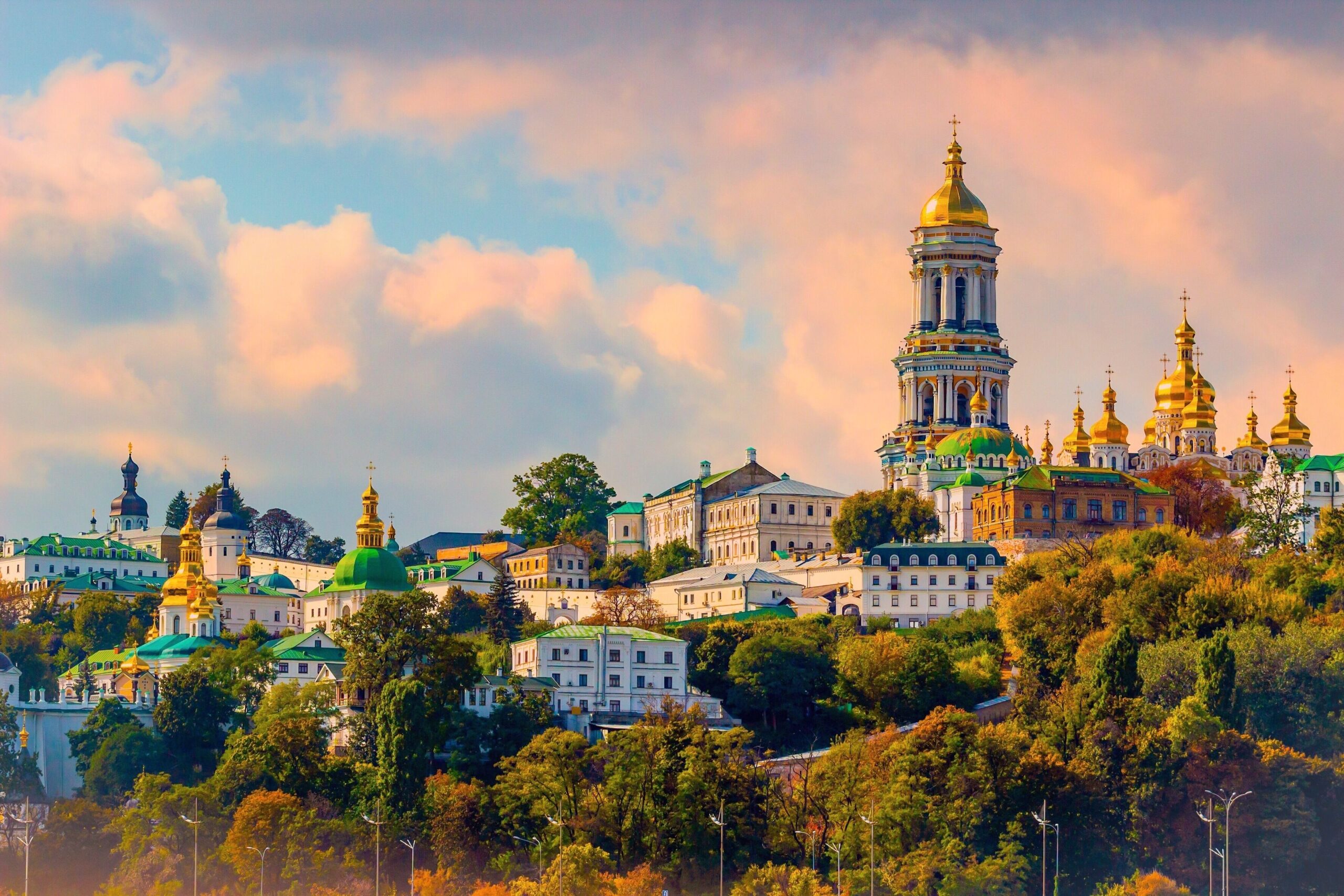
Historic Apartments in Kyiv: Lypky Prices, Investment Potential, and Buyer Guide
Why this area matters to foreign investors
Kyiv’s property market is navigating a complex period, but selective buyers remain active, especially in the historic center. For investors seeking historic apartments in Kyiv, few addresses combine status, scarcity, and architectural character like Arkhitektora Horodetskoho Street in Lypky, Pechersk.
This guide explains why pre-revolutionary and Stalin-era apartments in Lypky continue to attract buyers, how the local premium market behaves, what prices look like in 2026, and what investment opportunities are currently available. It also includes a real case study of a foreign client who purchased a historic apartment on Arkhitektora Horodetskoho Street in July 2026.
Key takeaways: investing in historic Lypky
- Lypky is Kyiv’s historic elite quarter: embassies, mansions, and some of the city’s most important pre‑revolutionary buildings.
- Old buildings here are a scarce asset: the number of authentic pre‑revolutionary and Stalin-era apartments in the center will never increase.
- Premium real estate in Kyiv has proven resilient, even during the full-scale war, supported by buyers who use property as a capital hedge rather than relying on mortgages.
- Typical prices in old buildings in historic Lypky range from about $2,000 to $5,000/m², depending on condition, floor, and street.
- Foreign buyers can purchase apartments in Kyiv with proper legal support and due diligence on the building/apartment.
- This article covers: the history of Arkhitektora Horodetskoho street, investment logic for old buildings, a real purchase case, and current apartments available for sale.
Pechersk and Lypky: Kyiv’s most prestigious address
Status rules everything here. Pechersk is an address that speaks for itself. It is home to the Government Quarter, the Lavra, parks overlooking the Dnipro, and the capital’s highest concentration of premium new developments. It attracts those who value status, as well as those who simply love waking up to views of golden domes and the river.
Lypky is the most prestigious part of Pechersk and the historic heart of Kyiv’s aristocracy: a district of embassies, mansions, and residences that have housed the city’s elite for over a century. It is quiet, green, and truly intimate, offering a city-center location without the usual urban bustle.
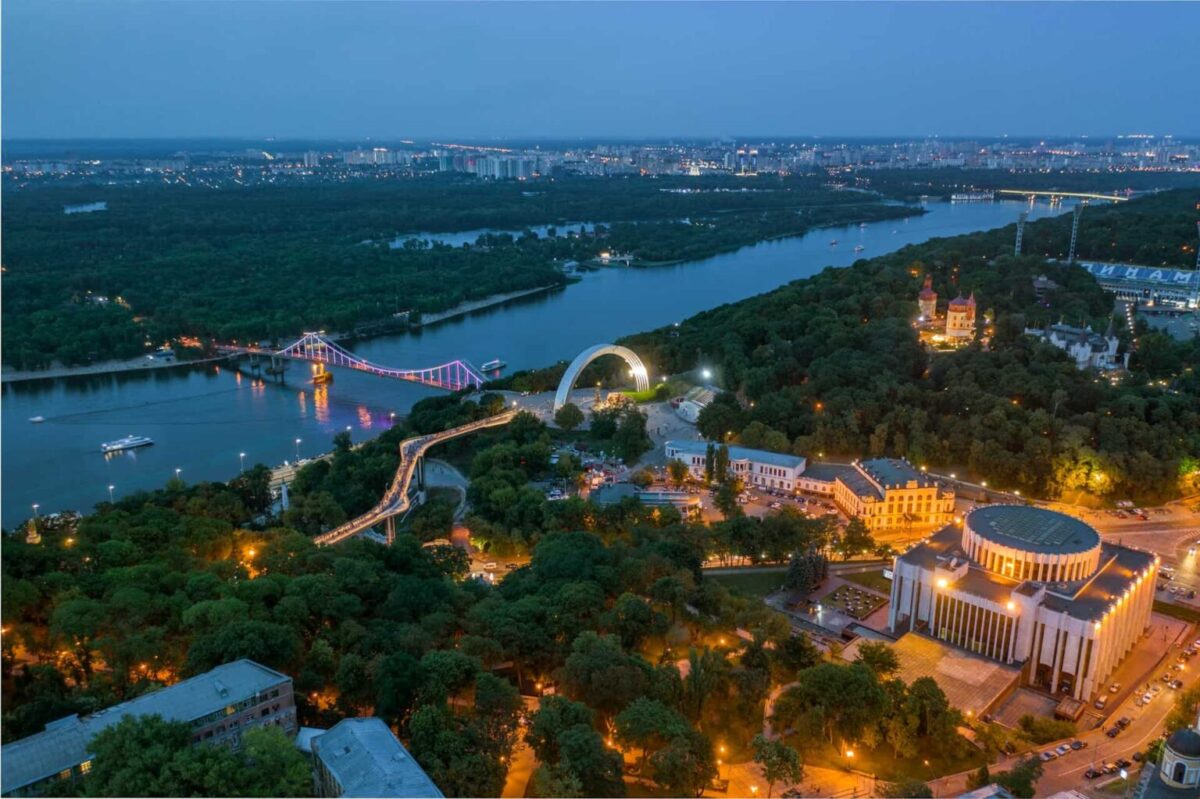
View of the Ukrainian House, pedestrian bridge, and arch. Source: kashtan.news
The area features pre-revolutionary apartment buildings, Stalinka-era residences with four-meter ceilings, and rare, exclusive new buildings from expensive developers. Supply is always limited, which is precisely why property values in Lypky remain strong, regardless of market conditions.
Kyiv’s premium market: prices, demand, and market trends
The luxury real estate market in Kyiv is a universe unto itself, governed by its own rules. While the economy segment reacts to every piece of news from the front lines and the comfort class quietly holds its ground, luxury housing in the capital operates according to a different logic. Prices may remain resilient during difficult times because premium properties attract a different buyer demographic.
Buyers in the premium segment rarely take out mortgages and are virtually unaffected by interest rates. They purchase property either to preserve funds in hard currency or to ensure a lifestyle of the highest comfort. That is why, even amidst a full-scale war, Kyiv’s luxury real estate market continues to demonstrate a level of resilience unseen in any other segment.
Key factors driving up prices in the premium segment include:
- A shortage of new premium projects. The number of new premium projects launching in Kyiv remains limited. Developers are entering the market cautiously, meaning supply cannot keep pace with demand in prime locations.
- Protection against hryvnia depreciation. Luxury real estate is priced in dollars and viewed as a hedge. While the hryvnia loses value, the dollar-denominated price per square meter remains stable or even increases.
- Market psychology. Owners of premium properties are in no rush to sell. They “freeze” their assets while waiting for better conditions, artificially restricting supply and preventing prices from falling.
- Relocation of businesses and professionals. A segment of internally displaced persons (IDPs) with higher purchasing power, along with entrepreneurs who relocated to Kyiv from occupied or frontline regions, are driving steady demand for high-quality housing.
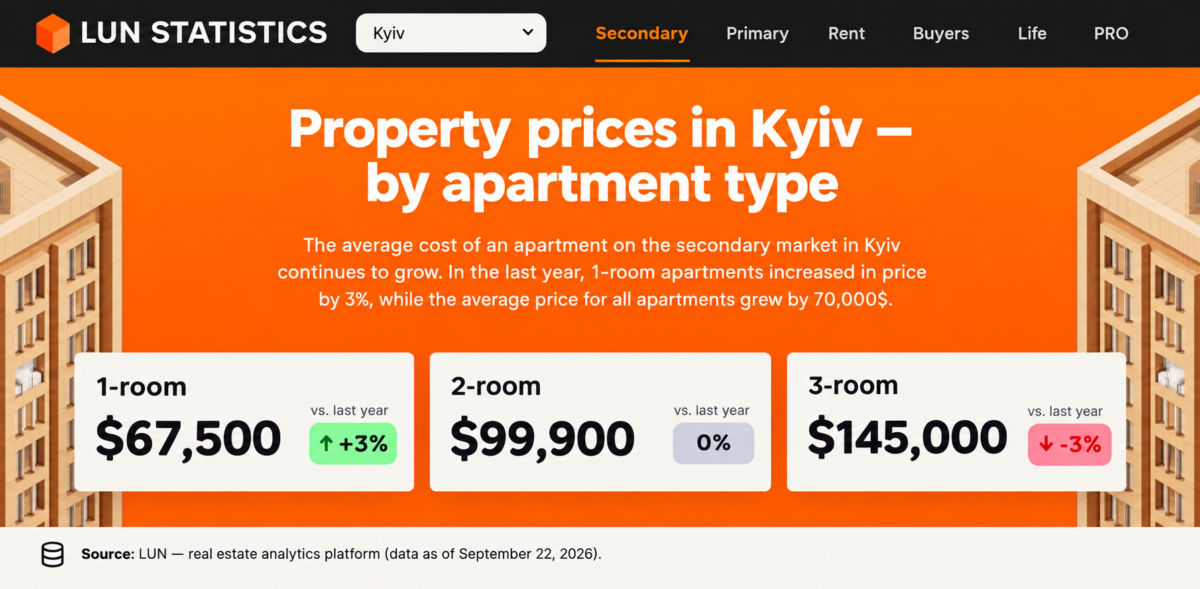
The average cost of housing on Kyiv’s secondary market continues to increase. According to LUN data accessed in September 2026, the median price of a one-room apartment in Kyiv was approximately $67,500, after increasing by about 3% in dollar terms over the previous six months. This is a Kyiv-wide indicator.
Pecherskyi district is the undisputed leader in the secondary real estate market, with prices per square meter hovering between $2,400 and $3,170, depending on the apartment’s condition (with or without renovation). These figures represent the district-wide median price as of September 2026.
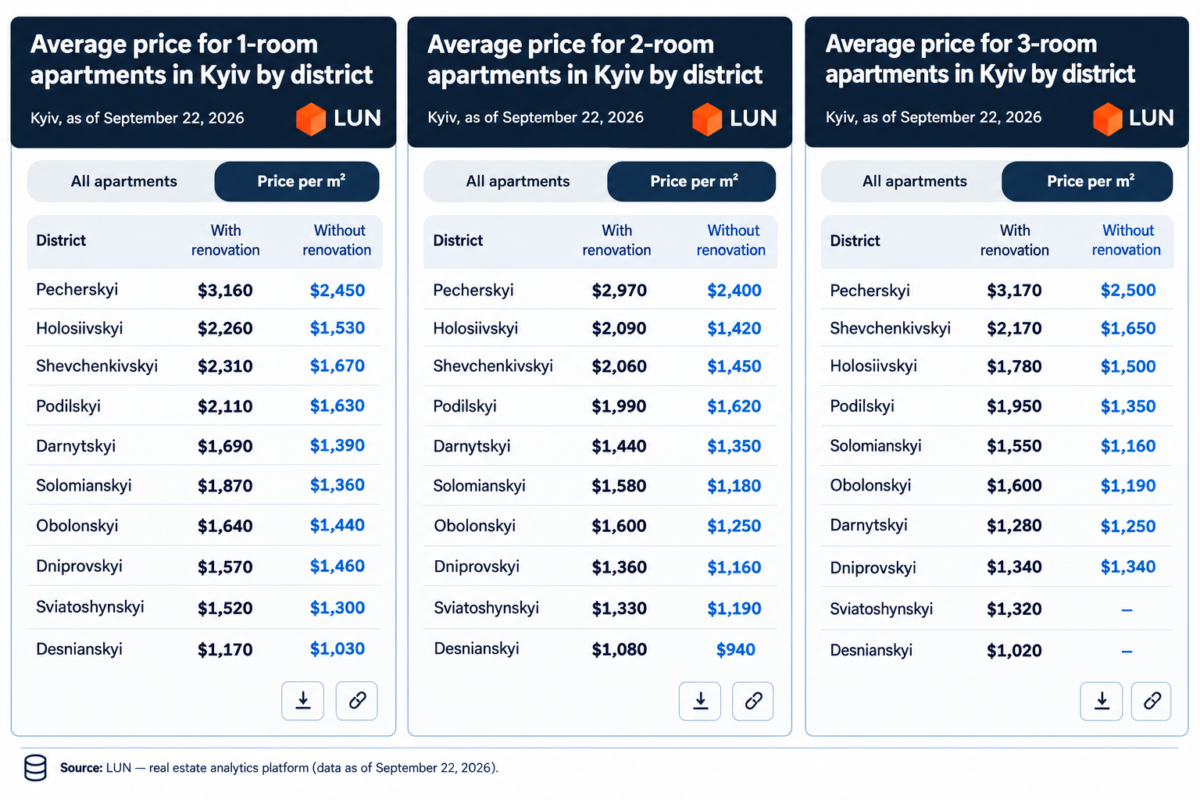
This trend is particularly evident in the premium property segment, where the cost per square meter in new residential complexes, even on the secondary market, may reach $2,000–$7,000 or more for apartments offering panoramic views of the Dnipro River or the Lavra. Prices in residential complexes located in Pecherskyi district in September 2026: Carnegie Tower ($2,000–$5,500/m²), Novopecherski Lypky ($4,000–$6,000/m²), Tetris Hall ($5,000–$8,000/m²), and Diamond Hill ($5,000–$12,000/m²).
Historic apartments in Kyiv: why Lypky’s old buildings attract investors
Iconic streets where the linden trees are older than the buildings, and the buildings tell the stories of generations. Embassies, residences, jewelry shops, high-end boutiques, and the finest restaurants and cafés offer the best choice to satisfy the most exquisite taste. Living in Lypky is like stepping back in time and experiencing the unique atmosphere of old Kyiv.
Who buys in Lypky?
Connoisseurs of history, status, and tranquility: diplomats and families who seek not merely to live in the hustle and bustle of the city center, but in a neighborhood that serves as the city’s heart and soul. In the evenings, you can hear classical music drifting from the Tchaikovsky Music Academy hall. The nearby Franko Theatre is well known for the finest contemporary plays, and tickets are hard to come by. The city’s best restaurant is just around the corner, while across the street, watch and jewelry collectors can acquire a new masterpiece for their collections.
Beyond status-conscious buyers, diplomatic staff, and the cultural elite, another type of buyer should consider purchasing a home in this area: the visionary investor who recognizes the timeless value of such properties. Buying a home in pre-revolutionary buildings or Stalin-era properties is a sound investment, mainly because of their limited supply, unique architecture, and high construction quality. Unlike modern buildings, the number of such properties on the market will never increase. That scarcity, combined with unique architecture and a central location, can support long-term demand. However, resale liquidity still depends on the apartment’s condition, layout, legal status, price, and market conditions.
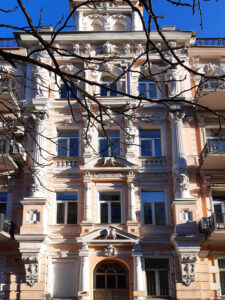
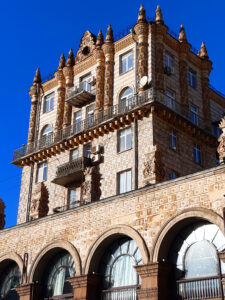
Pre‑revolutionary buildings vs. Stalin-era: what’s the difference?
| Feature | Pre‑1917 | Stalin-era (1930–1950) |
| Facade & decor | Stucco molding, atlantes, unique corner balconies, grand entrances | Monumental classicism, austere, majestic forms |
| Structure | Durable brick; often wooden or mixed floor structures | Predominantly reinforced concrete floors (later versions) |
| Ceilings & space | High ceilings; enfilade or former communal layouts | Spacious separate rooms, square entrance halls |
| Main value driver | Historical and cultural exclusivity – “buildings with a history” | Soviet elite luxury – structural reliability and generous layouts |
 |
 |
Why invest in old buildings here?
Premium location and infrastructure. These properties sit in the city’s most prestigious district, where there is virtually no space left for new construction. Central metro stations, public transport stops, and key thoroughfares are nearby, while numerous green courtyards, parks, top-tier schools, theaters, restaurants, and museums are within walking distance.
Architectural advantages. Ceiling heights ranging from 3 to 4.5 meters create a sense of spaciousness, allow for abundant natural light, and enable unique design solutions. These buildings were constructed using high-quality brick, with wall thicknesses often reaching 60–80 cm. This ensures excellent sound insulation and natural thermal regulation (warm in winter, cool in summer). Apartments typically feature spacious rooms, well-proportioned layouts, and large windows.
Investment potential and return on investment. Real estate in the historic Lypky district is highly resilient to devaluation during economic downturns. Such apartments can appeal to foreigners, diplomats, expats, and local buyers who value authentic architecture and a central address. They are suitable for both long-term rentals and short-term stays (e.g., via Airbnb). As of September 2026, the price per square meter for an apartment in Kyiv’s older housing ranges from $2,000 to $5,000, depending on the unit’s condition. Average high-quality renovation costs start at around $1,500/m². With this investment, the buyer gains not only prestigious housing, a prime location, and distinctive architecture but also the potential for an attractive gross rental yield of approximately 7–8%. The gross yield is slightly lower than in the Golden Gate area, but because the Lypky area has a high-status reputation, prices per square meter are higher, which lowers the gross yield.
Vestor.Estate offers exceptional historic apartments for sale in the historic Lypky district on Zankovetskoi Street 3 and Zankovetskoi Street 6. Long-term rental rates for comparable apartments start at $3,500 per month, and based on our rental experience, these apartments are rarely vacant.
For instance, comparable historic apartments renting for $3,500 per month would generate annual gross rental income of $42,000. A 100 m² apartment purchased for approximately $350,000, including legal, notary, and agency fees, would require an estimated $150,000 renovation budget at $1,500/m². The total investment would therefore be approximately $500,000, resulting in an estimated gross rental yield of about 8.4%.
$42,000÷$500,000×100 = 8.4%
This is a gross estimate calculated before vacancy, management, maintenance, and utility costs. Actual returns depend on the specific apartment, renovation quality, achievable rent, and rental strategy.
Arkhitektora Horodetskoho Street: a living museum of Kyiv’s history
This street is a true gem in the very heart of Kyiv. It took shape in the late 19th century during the development of the former estate of Friedrich Mering (1822–1887), a professor of medicine at Kyiv University. Its uniqueness lies in how completely it has preserved the charm of late 19th‑ and early 20th‑century Kyiv, with an abundance of exquisite historical and architectural landmarks. The street is also associated with many prominent Kyivans, as well as notable figures from Ukrainian theater and cinema.
A brief look back at history helps us understand why this part of the city matters and why the street’s status has remained consistently high for over a century.
Kyiv’s answer to Gaudí
Vladyslav Horodetsky is known as Kyiv’s Gaudí. Like his Catalan contemporary, he loved experimenting with forms, creating unique, fantastical buildings. His most famous creation is the House with Chimeras in Kyiv. This brick structure, adorned with mythological and hunting-themed decorations, stands as a prime example of early Neo‑Gothic architecture in the city. It derives its name from sculptural ornaments depicting terrestrial and aquatic wildlife, hunting motifs, and mythical creatures. Horodetsky built the house in 1903 for his family; he and his relatives lived on the ground floor, while the upper-floor apartments were rented out. The architect was an avid hunter, so the interior features sculptures and hunting trophies, including skulls, antlers, and taxidermy mounts of animals and birds.
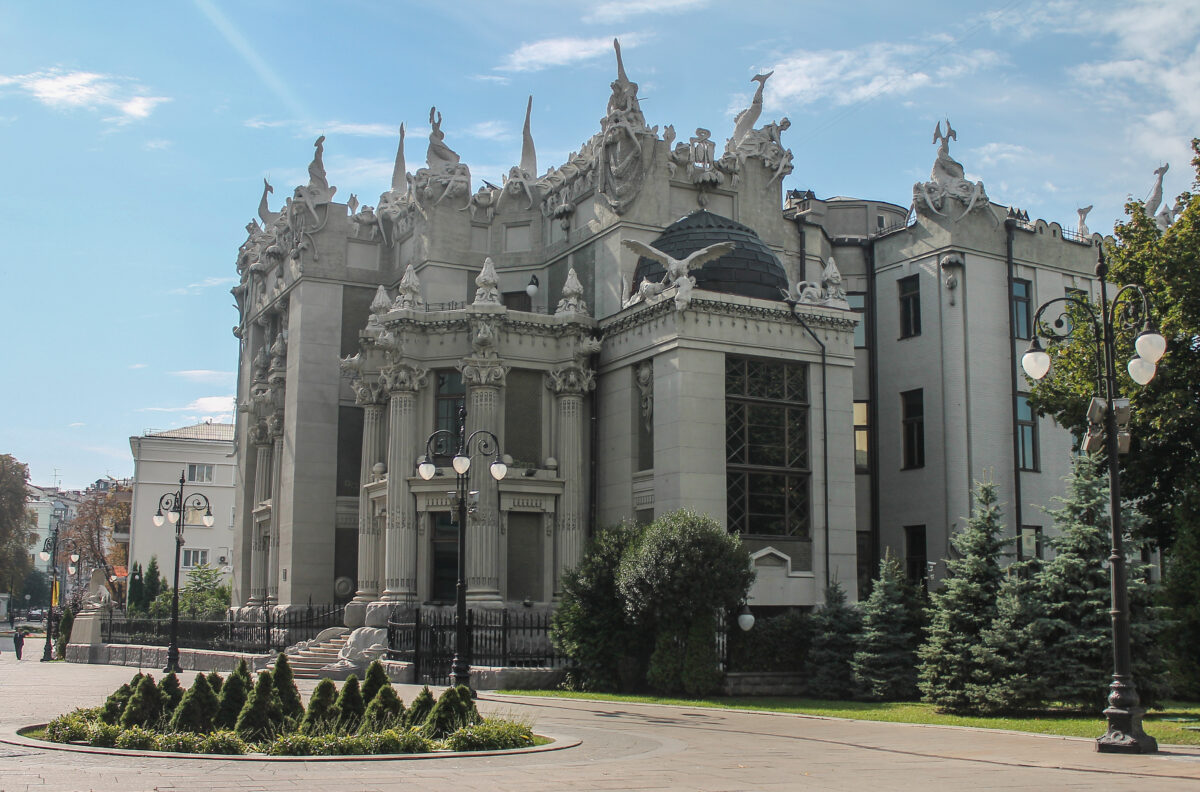
House with Chimeras in Kyiv. Source: Wikipedia
From the Mering estate to “Kyiv’s Paris”
Until the mid‑19th century, this area remained part of an undeveloped expanse between Instytutska and Luteranska streets. In 1862, Emperor Alexander II gifted the estate to Major General Fyodor Trepov, who later sold the property to the renowned medical professor Friedrich Mering. He had already been buying smaller plots in the area; eventually, his holdings expanded to over 10.5 hectares. The professor set aside a large part of the site for a public garden and allowed the construction of a new street.
Mering’s Garden became a favorite leisure spot for Kyivans, featuring greenhouses, gardens, vineyards, and a pond with a bathing area that transformed into an ice rink in winter. Professor died in 1887, just as a construction boom was beginning in Kyiv; his estate subsequently became highly attractive for commercial development projects.
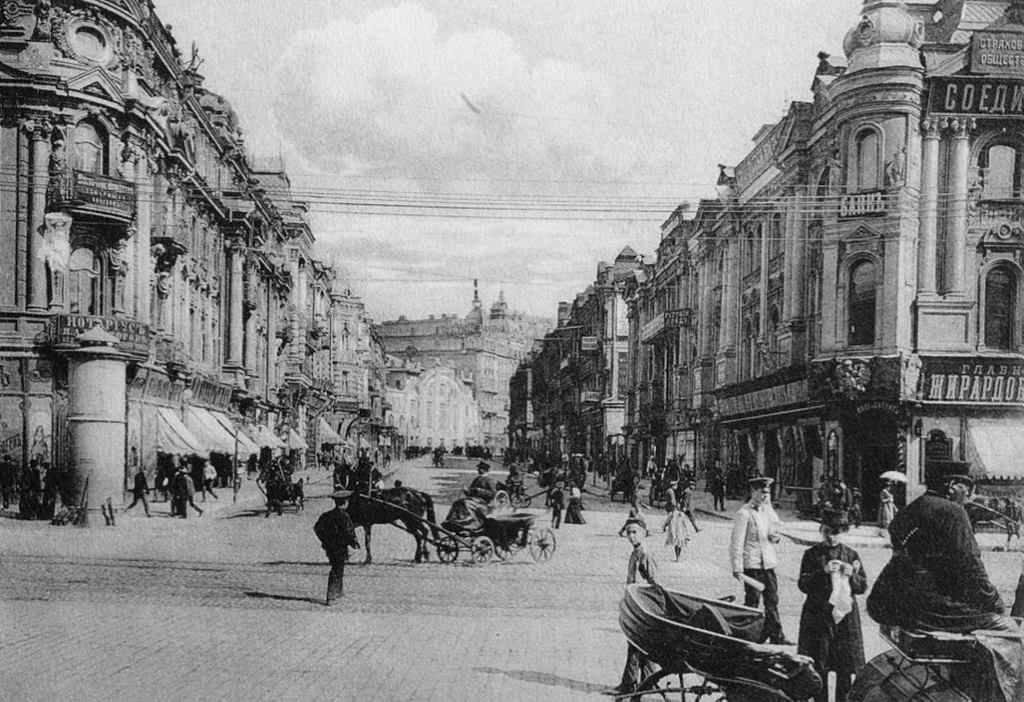
Development of the estate began in 1895–1896, and four new streets were soon laid out: Mykolaivska (now Arkhitektora Horodetskoho Street), Olhynska, Merynhovska, and Nova, while Mykolaivska Square was created on the site of the former pond. Prominent Kyiv architects—Vladyslav Horodetskyi, Heorhii Shleifer, Eduard‑Ferdinand Bradtman, Mykola Kazanskyi, Martyn Kluh, and Mykola Yaskevych—left their unique masterpieces here. Due to its exquisite and grandiose architecture, the area was named “Kyiv’s Paris.” Unfortunately, not all of these buildings survived the dramatic events of the Second World War.
Hotel Continental (Arkhitektora Horodetskoho Street 5)
Built in 1897, the Hotel Continental was considered one of Kyiv’s finest hotels at the time. Prominent architects of the era, Heorhiy Shleifer and Eduard‑Ferdinand Bradtman, designed the magnificent building; Vladyslav Horodetskyi also participated, working on the interior layout. The four‑story hotel was designed in the Renaissance style and featured exceptionally refined and lavish ornamentation. The interior décor was particularly striking in its opulence. Due to its luxurious interiors and high level of service, the Continental was compared to the best hotels in America and Europe.
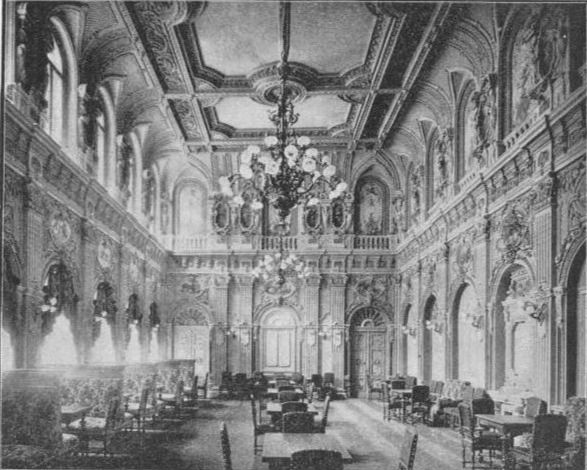
In 1941, the building, along with the Nazi headquarters housed within it, was blown up by Soviet saboteurs. After World War II, the facility was restored in a much simplified form. Today, it houses the P. Tchaikovsky National Music Academy of Ukraine. The building at Arkhitektora Horodetskoho Street 5 stands as a living example of how Kyiv’s architecture preserves layers of different eras. Musicians study here today, yet the walls still hold memories of the luxurious hotel, the bohemian underground, and the devastation of war.
Ginzburg House (Arkhitektora Horodetskoho Street 9)
Constructed between 1900 and 1901 and designed by Heorhii Shleifer and Eduard Bradtman, the house belonged to Lev Ginzburg. With its lavish ornamentation and imposing scale, it stands as one of Kyiv’s most grandiose structures, serving as an advertisement for its owner, a renowned building contractor. The ground and first floors housed the famous Kyiv furniture store “Ya. & Y. Kohn,” while the upper floors contained spacious rental apartments ranging from three to seven rooms.
Its opulent façade design made it a true architectural exemplar of the era. Sculptures of Hermes and Hera remain atop the roof, centered on the crowning parapet. Figures of Demeter, Hermes, Athena, and Hephaestus stand in the wall sections of the top floor. Chimera heads with open mouths appear along the perimeter, and Atlantes support the balconies. Without exaggeration, Ginzburg House ranks among Kyiv’s most fascinating buildings.
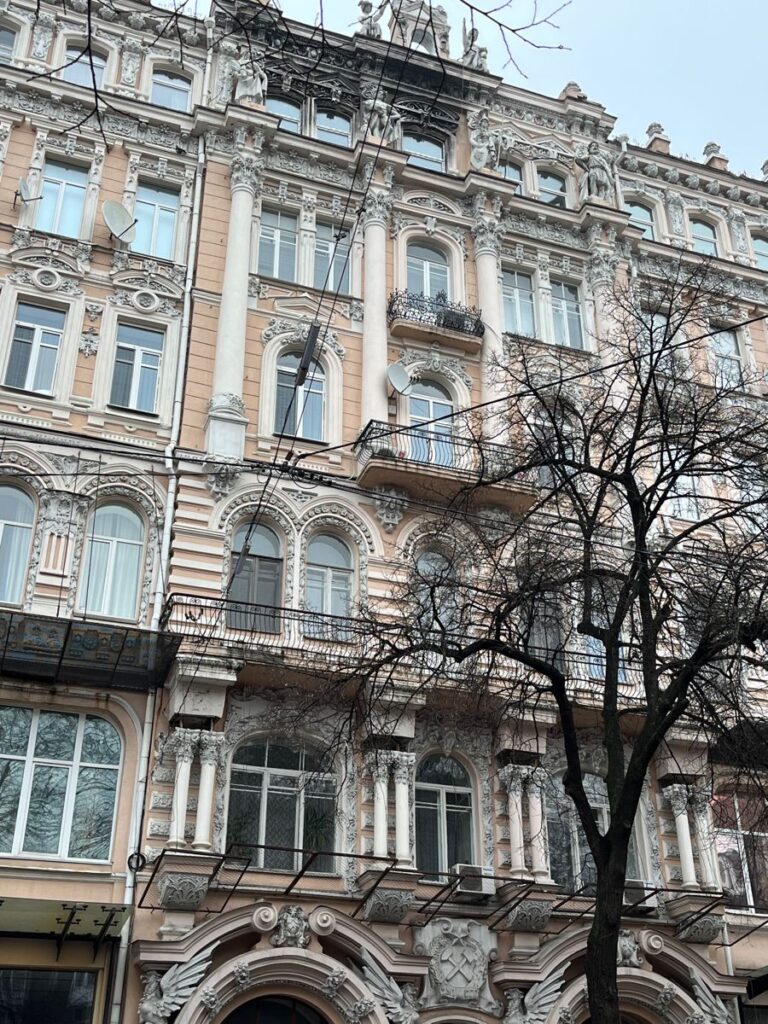
Ginzburg House Architectural Details. Photo by Vlada Kuzinska
Baron Hesselbein House (Arkhitektora Horodetskoho Street 15)
The building at 15 Arkhitektora Horodetskoho Street is one of Kyiv’s finest examples of early Art Nouveau architecture. Built in the early 20th century, it was commissioned by the Prussian Baron Wilhelm Hesselbein and designed by the renowned architectural duo Eduard Ferdinand Bradtman and Georgi Schleifer—the creators of “Kyiv’s Paris.”
This house is considered one of Kyiv’s most striking and original. Beyond its official designation as Hesselbein’s revenue house, it bears the poetic name “Cradle of the Spirit,” as it conceals many secrets and mysteries. The façade encodes the ancient Greek myth of Zeus’s birth. At the top, one can see the head of the god Cronus (Saturn), symbolizing the passage of time.
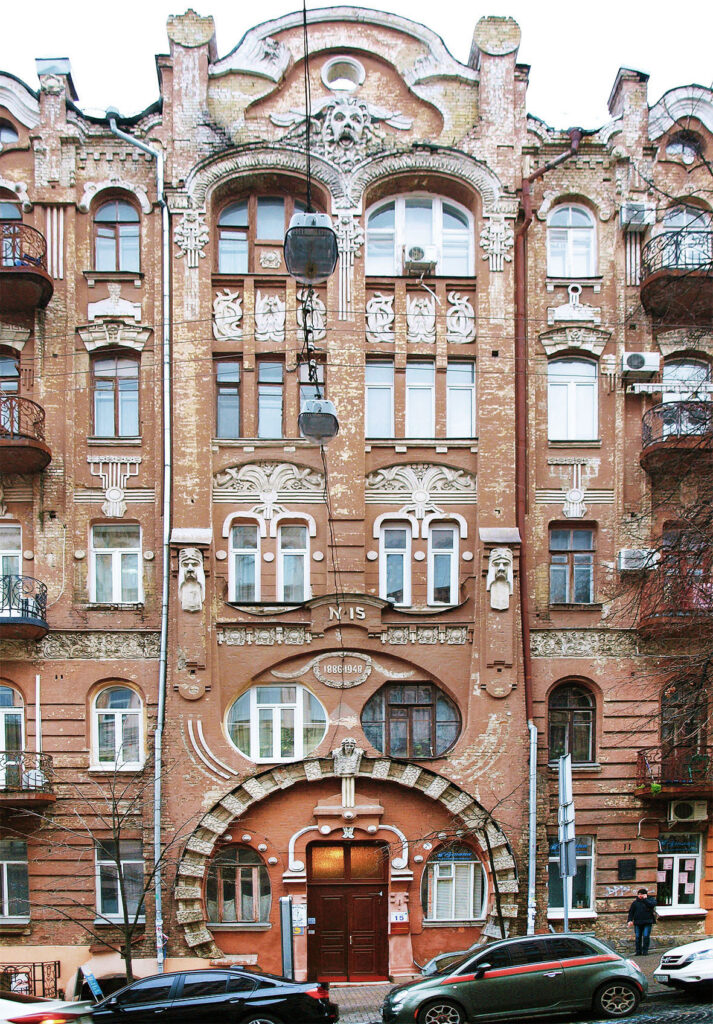
Baron Hesselbein House Façade, Kyiv. Source: Wikipedia
The numbers on the façade—1886–1948—remain a mystery to many Kyivans. Researchers believe the building could not have been constructed in 1886, as the site was then part of the Mering estate and had not yet been opened for development; actual construction likely began between 1901 and 1903. Scholars offer several theories: the numbers may have been misplaced during a renovation, or restorers might have mistakenly inscribed the date, confusing the street’s development period with the founding year of the owner’s furniture company (which appears on another building). Another version dates the start of construction to 1898—a date that was mistakenly changed to 1886 during post‑war reconstruction.
Arkhitektora Horodetskoho Street is a historic gem of Kyiv, known for its unique architecture and rich history that captivates everyone who walks past these majestic, distinctive buildings.
What’s available on Arkhitektora Horodetskoho Street in September 2026
Listings checked in September 2026. Prices and availability may change.
Apartments on Arkhitektora Horodetskoho Street in Kyiv rarely come up for sale. It is a short, highly prestigious historic street in the city center (Lypky / Maidan Nezalezhnosti) with a limited number of pre‑revolutionary and Stalin-era buildings. Vestor.Estate currently presents a few meaningful opportunities for investors who value history and location.
Arkhitektora Horodetskoho 10/1 – Pochtar Revenue House (1900, architect Mykola Yaskevych)
- Pre‑revolutionary revenue house on a prominent section of the street.
- High ceilings, classic layout, ornate facade typical of early 20th‑century Kyiv.
- Suitable for long-term rental to expats/diplomats, or a renovation project for own use.
- Price: $350,000
- View listing
Arkhitektora Horodetskoho 15 – “Cradle of the Spirit” (1901–1903, architects Eduard Ferdinand Bradtman and Georgi Schleifer)
- Officially recognized as a monument of local architectural significance.
- Distinctive symmetrical façade decorated with mythological motifs, specifically scenes from ancient Greek mythology.
- Ideal for lovers of luxury historic real estate who prioritize status, unique architecture, and a prestigious location in the Lypky district.
- Price: $550,000
- View listing
Arkhitektora Horodetskoho 12/3 – A. F. Berliner’s Revenue House (1909, architect Mykola Yaskevych)
- Part of the famous “Kyiv Paris” and still a magnet for the capital’s elite.
- Pre‑revolutionary building of high-quality brick, with a ceiling height of 3.8 meters.
- Ideal for high-budget buyers who value status, history, and life at a top city address.
- Price: $900,000
- View listing
Case study: buying a historic apartment on Arkhitektora Horodetskoho Street
Our client, an American investor, was looking for a historic apartment in central Kyiv with three main criteria: authentic pre‑revolutionary or Stalin-era character, a practical layout and a good view, and a central location. Originally, he didn’t focus on a specific street or building—only a central address, a practical layout, and good quality mattered.
After reviewing several options in the city center, he realized he wanted something distinguished, with clear architectural value. He said: “I want to live in a building that doesn’t look like it can be anywhere in the world. I want something that speaks loudly—I’m in Kyiv.” From that moment, we knew Arkhitektora Horodetskoho Street would catch his interest—specifically the apartment in one of Kyiv’s most decorated revenue houses, known for its mythological sculptures and rich history. What convinced the buyer was not only the facade, the apartment layout, and a building that holds its value even in a complicated market, but the feeling of becoming part of a larger story—grand and majestic.
The process included multiple viewings, detailed checks on the apartment’s condition and ownership structure, coordination with lawyers, and careful preparation of the offer and notary documents. From first viewing to registration, the transaction took about 3 weeks (the client was traveling in and out of Kyiv), with a total budget of about $325,000 (without renovation costs).
Our client now owns an apartment in one of Kyiv’s most recognizable historic buildings on Arkhitektora Horodetskoho. This asset combines architectural uniqueness, a top address, and potential long-term appeal for both personal use and rental investment.
Foreign investors’ top questions about historic Kyiv apartments
Can foreigners buy apartments in Kyiv?
Yes. Foreign individuals can buy residential apartments in Kyiv. Restrictions mainly concern agricultural land, not flats in multi‑apartment buildings.
What documents does a foreigner need to buy an apartment in Kyiv?
Typical documents include:
- Ukrainian tax ID (obtained in 2–5 days with your original passport).
- Notarized Ukrainian translation of your international passport (done in Ukraine).
- International passport with a legal entry stamp or a valid visa.
- Notarized spouse consent if registering the property as joint ownership.
- Apostilled Power of Attorney (PoA) if buying remotely.
The Vestor.Estate team regularly assists foreigners with tax IDs and full purchase processes.
What is the typical process and timeline?
A standard purchase takes 2–4 weeks if all documents are ready. Remote purchases via PoA may require an additional 2–3 weeks for document shipping and legalization. Typical stages:
- Document and tax ID preparation: 3–7 days
- Property selection and due diligence: 3–10 days
- Preliminary agreement and deposit: 1 day
- Main deal and state registration: 1–3 days
What costs should I plan for?
Budget an additional 5–8% above the purchase price for taxes, notary fees, legal checks, agency fees, and banking expenses.
How do I get a tailored shortlist for Arkhitektora Horodetskoho / Lypky?
Contact Vestor.Estate to receive tailored property options on Arkhitektora Horodetskoho Street, in the Lypky area, or Kyiv city center.
If you would like a curated shortlist of historic apartments on Arkhitektora Horodetskoho Street and in Lypky (including off‑market options), contact Vestor.Estate for a private briefing and viewings.

